Newsletters


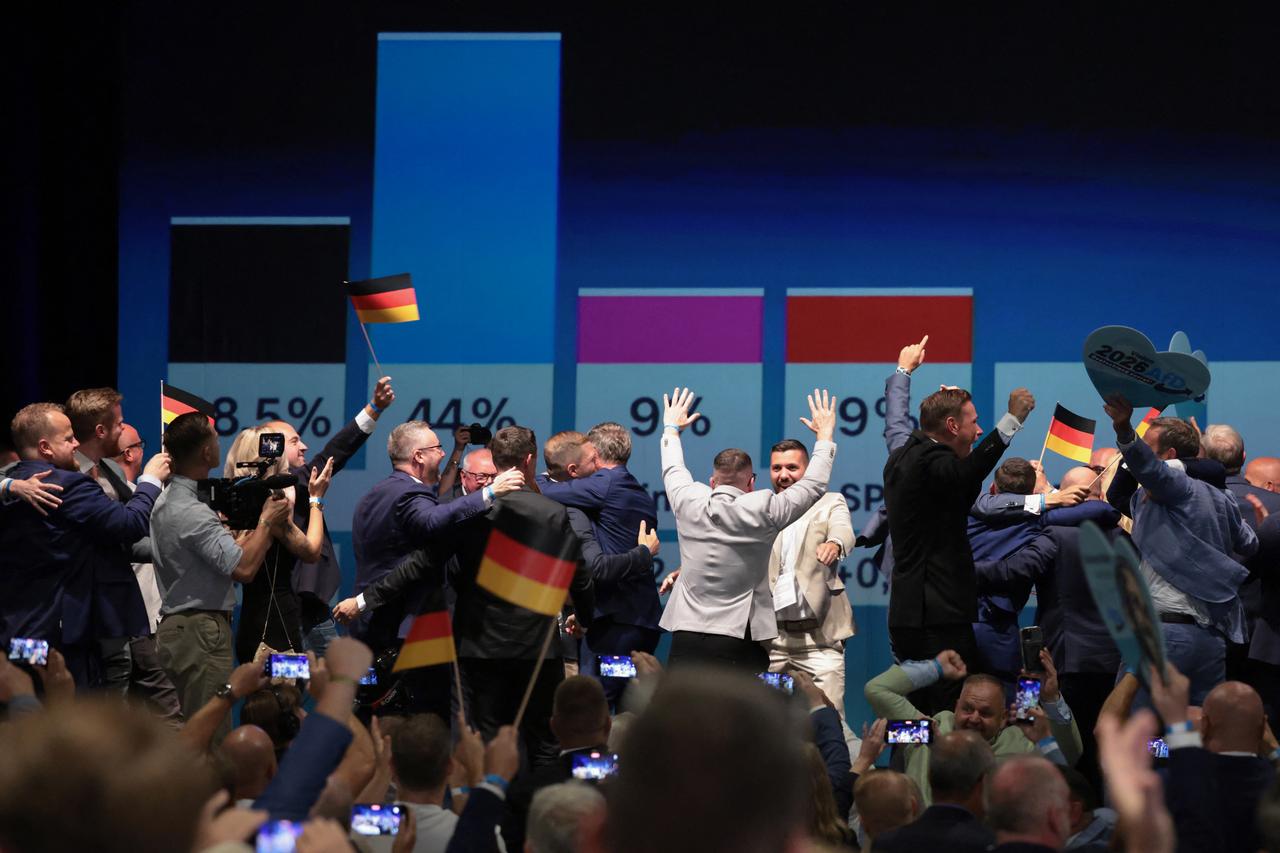


Germany's far-right Alternative for Germany party claimed a commanding lead in Sunday's regional election in Saxony-Anhalt, exit polls showed, putting the party within reach of a feat it has never achieved in its 13-year history: leading a German state government for the first time since World War II. Whether AfD secured the outright majority it needed to govern alone remained unclear.
Exit polls conducted for public broadcasters ARD and ZDF showed AfD winning around 44% of the vote in the eastern state, more than double its result five years ago.
The Christian Democratic Union, the center-right party of Chancellor Friedrich Merz that has governed Saxony-Anhalt for 24 years, trailed far behind at roughly 18.5%, losing about half of its previous support.
The exit polls indicated AfD fell at least marginally short of the absolute majority it would need to form a government on its own.
AfD entered the vote seeking to overcome what is widely known in German politics as the "firewall," the informal but firmly held refusal by mainstream parties to enter coalitions with the far-right party.
A win in Saxony-Anhalt, a state of 2.1 million people west of Berlin, would hand AfD its first state government and mark a symbolic setback for Merz, whose CDU has dominated the region for more than two decades.
The Left Party was on track to finish third with about 9% support, while the center-left Social Democrats and the Greens each polled between 8% and 9%, enough to remain in the state legislature. It remained unclear whether the BSW party would clear the 5% threshold required to win seats.
Ulrich Siegmund, who heads AfD's branch in Saxony-Anhalt, declared victory shortly after the exit polls were released. "We've made history, we need to say this clearly," he told ARD.
He characterized the outcome as a message aimed squarely at the national government in Berlin, which Merz leads.
Asked about the prospects of forming a coalition, given that most other parties have ruled out cooperating with AfD, Siegmund signaled the party would not compromise its platform to gain power.
"We will not give away our basic positions for the sake of being in power," he said, adding that AfD remained open to cooperation on its own terms.
Saxony-Anhalt accounts for less than 3% of Germany's national electorate, but the result is expected to be closely watched as a gauge of AfD's momentum nationally.
The vote comes amid what organizers described as widespread discontent with an unpopular federal government that has struggled to convince voters it can revive the country's sluggish economy.


 Set as preferred source
 Set as preferred source


 2 min read


 1 min read